Why You Need a Battery Monitor
Voltage alone does not tell you how much battery you have left. A 12V lithium bank can read 13.1V at 80% and 13.0V at 30%. By the time voltage drops noticeably, you are already in trouble. A battery monitor tracks current in and out over time and gives you an accurate state of charge — like a fuel gauge instead of a check engine light.
The Victron SmartShunt
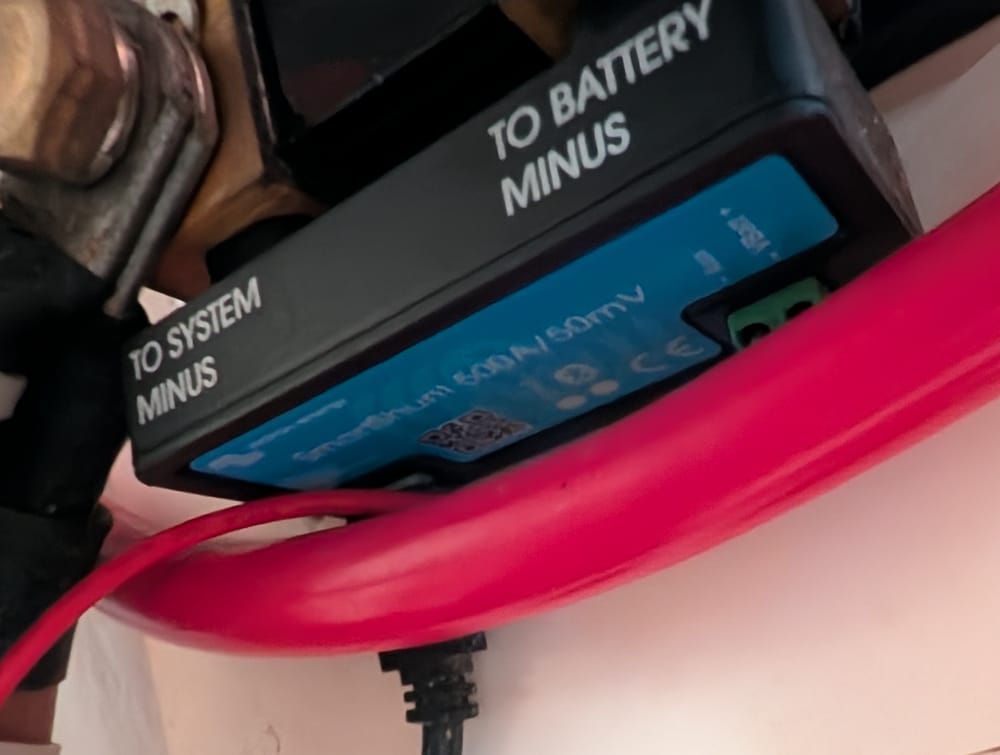
The Victron SmartShunt 500A is the monitor we run on our boat and the one we recommend for most RV and marine installations. It is a shunt-based coulomb counter — it sits on the negative battery cable and measures every amp flowing in and out of your bank.
What makes it better than the competition:
- Bluetooth built in. Open the Victron Connect app on your phone and see state of charge, voltage, current draw, and time remaining. No extra display needed.
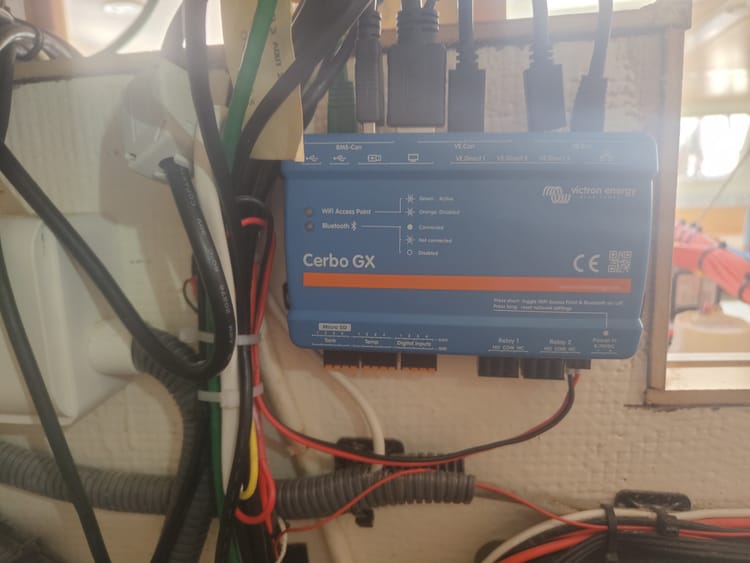
- VE.Direct port. If you run a Victron Cerbo GX or GX Touch, the SmartShunt feeds directly into your system monitoring dashboard. This is where it really shines — full historical data, remote monitoring via VRM, and trend alerts.
- Midpoint voltage monitoring. If you have a 24V bank made of two 12V batteries in series, the SmartShunt can detect imbalance between them before it becomes a problem.
- Accurate. The 500A/50mV shunt handles up to 500A continuous. For most RV and boat systems, this is more than enough headroom.
→ Victron SmartShunt 500A on Dupree Products
Installation Basics
The SmartShunt installs on the negative side of your battery bank. All negative loads and charging sources must pass through the shunt — this is how it counts every amp. If anything bypasses the shunt (a ground wire bolted directly to the battery negative, for example), your readings will drift.
The wiring is straightforward:
- Mount the shunt close to your battery bank.
- Connect the battery negative to one side of the shunt.
- Connect all negative loads and charge sources to the other side.
- Run the small sense wire from the shunt to battery positive (this measures voltage).
- Open Victron Connect and configure your battery capacity, chemistry, and charge parameters.
Total install time is about 30 minutes if your wiring is already accessible. The hardest part is usually rerouting any negative wires that bypass the shunt.
What About Cheaper Options?
You can buy a battery monitor for $25 on Amazon. We have tested several. The problem is not accuracy on day one — it is accuracy on day 30. Cheap shunts drift, lose calibration, and do not sync properly after full charges. The SmartShunt auto-syncs when it detects a full charge and maintains accuracy over months.
The Victron ecosystem is the other reason. If you ever add a solar charge controller, inverter, or Cerbo GX, the SmartShunt already speaks the language. You are not buying a standalone gadget — you are buying into a monitoring platform.
SmartShunt vs BMV-712
Victron also makes the BMV-712, which is the SmartShunt with a dedicated display panel included. If you want a permanent mounted display showing state of charge, the BMV-712 is the way to go. If you are fine checking your phone or already have a Cerbo GX display, the SmartShunt saves you money and mounting space.
The Bottom Line
If you have a battery bank worth protecting — lithium especially — the SmartShunt is the right monitor. It is accurate, integrates with everything Victron makes, and the Bluetooth app alone is worth the price. Stop guessing your state of charge.
→ Victron SmartShunt 500A on Dupree Products