You Need a Handheld VHF
Your fixed-mount VHF radio is the primary communication system on your boat. But a handheld VHF is the backup that saves you when the fixed mount fails, when you are in the dinghy, or when you need to communicate from the deck without running below.
Every boat should have at least one handheld VHF aboard. If you are cruising offshore, carry two.
What Actually Matters in a Handheld VHF
Most handheld VHF radios sold today are fine. The feature wars between manufacturers are mostly irrelevant for practical use. Here is what actually matters:
- Flotation and visibility: use a lanyard too; floating does not make a dropped radio easy to recover.
- Water resistance: both the HX210 and original IC-M25 are rated IPX7. Inspect seals and follow the manual.
- Battery and charging: compare the charging connector and the manufacturer’s test conditions, not just an hour figure.
- Controls: make sure you can find the distress/hailing channel and use the buttons easily.
- Transmit power: range also depends on antenna height and conditions; a wattage figure is not a range guarantee.
Our Pick: Standard Horizon HX210
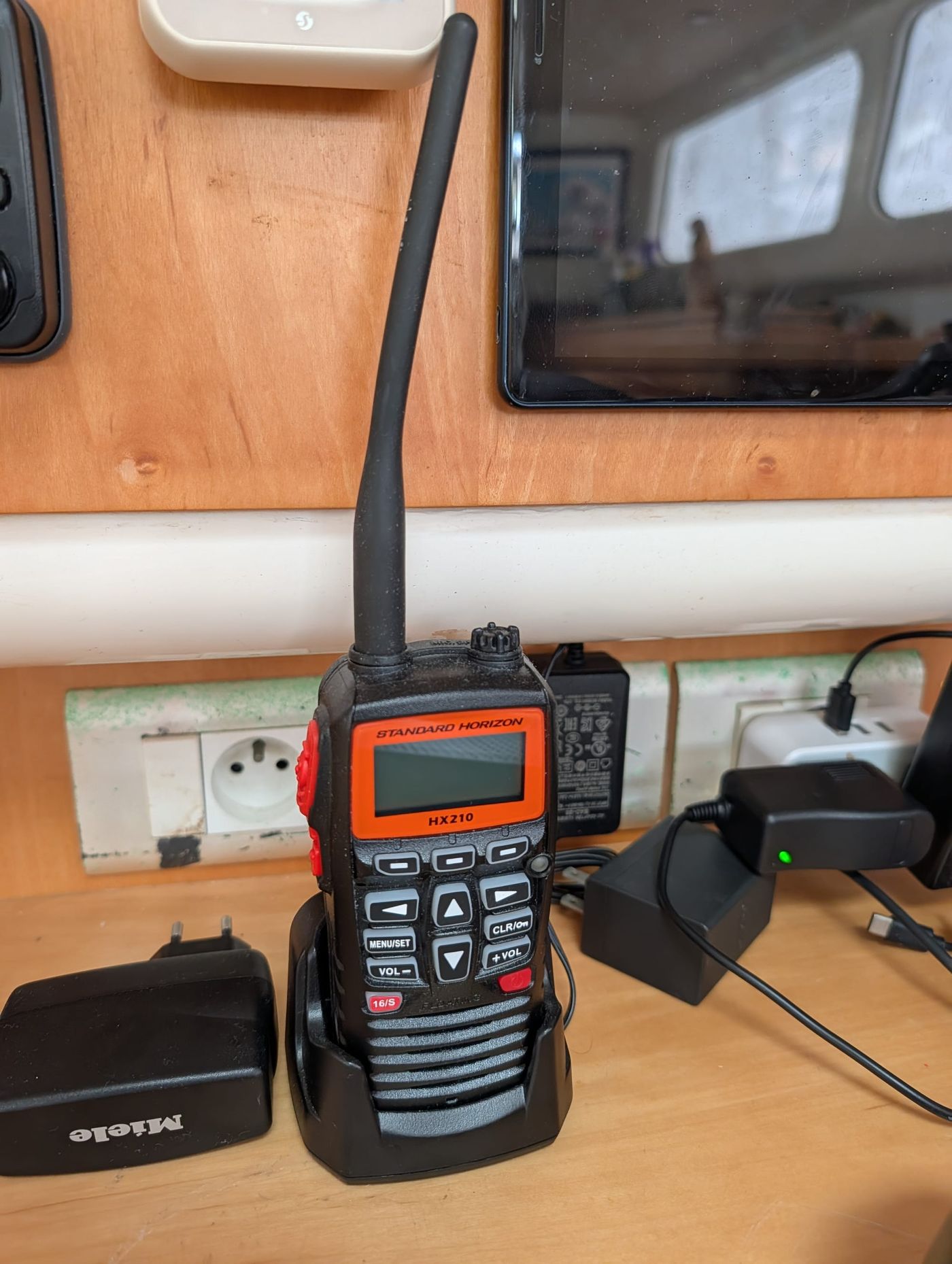
We carry the Standard Horizon HX210 aboard. It floats, is IPX7 rated and has straightforward physical controls. Simple operation is a bigger part of its appeal to us than a long list of extra features.
The HX210 also has a built-in FM radio, which is a surprisingly useful feature at anchor or on the beach. Not a reason to buy it, but a nice bonus.
Check the current price rather than relying on an old sub-$100 listing. The HX210 is the model we use; that firsthand experience is the basis of our pick.
→ Standard Horizon HX210 on Dupree Products
Runner Up: Icom IC-M25
The original Icom IC-M25 is a slim floating alternative with IPX7 protection and Micro-B USB charging. Do not confuse it with the newer IC-M25 EVO: the EVO uses USB-C and is a different generation.
Icom specifies about 11 hours for the original IC-M25 under its stated duty cycle. We carry the HX210; the Icom discussion here is a feature comparison, not an equivalent long-term test of both radios.
What About DSC?
Digital Selective Calling (DSC) lets you send a digital distress signal with your GPS position at the push of a button. On a fixed-mount radio, DSC is essential and you should absolutely have it configured with an MMSI number.
A basic voice-only handheld and a DSC/GPS handheld serve different needs. Neither model compared here has built-in GPS or DSC. If those features matter to your use, compare a suitable DSC handheld separately rather than assuming a fixed radio makes them unnecessary.
Tips for Carrying a Handheld VHF
- Keep it in a waterproof bag with a lanyard when in the dinghy. Even floating radios are hard to spot in waves.
- Program your local channels before you need them — harbor control, marina, bridge tenders, tow services.
- Test the battery monthly. A dead handheld in the ditch bag is worse than no handheld at all.
- Carry a spare battery pack if you are going offshore. Cold weather kills battery life.
The Bottom Line
The HX210 remains our pick based on carrying it aboard. The original IC-M25 is worth comparing if size and USB charging are priorities. When buying today, check the model generation, charging arrangement, included accessories and current price.
Related Articles
Specifications: Standard Horizon HX210 documentation and Icom’s original IC-M25 brochure. The M25 EVO brochure covers the newer model.