Why Shelly on a Boat?
Shelly devices are compact smart relays designed for home automation. They are also, accidentally, some of the best automation hardware for boats and RVs — because they run on DC, they are tiny, and they work with Home Assistant over Wi-Fi without needing cloud services.
We run multiple Shelly devices aboard our sailboat. They control lights, monitor temperatures, and automate systems that used to require manual switches or expensive marine-specific controllers.
The Key Models for Marine Use
Shelly 1 Mini Gen4
This is the workhorse. A single-channel smart relay small enough to fit behind a switch or inside a panel. It handles up to 8A on DC, which covers most lighting and fan circuits on a boat.
We use these to:
- Automate anchor lights — turn on at sunset, off at sunrise
- Control cabin LED strips via Home Assistant dashboards
- Create smart switches that also work as physical toggles (the relay passes through, so the manual switch still works if Wi-Fi drops)
Shelly H&T Gen3
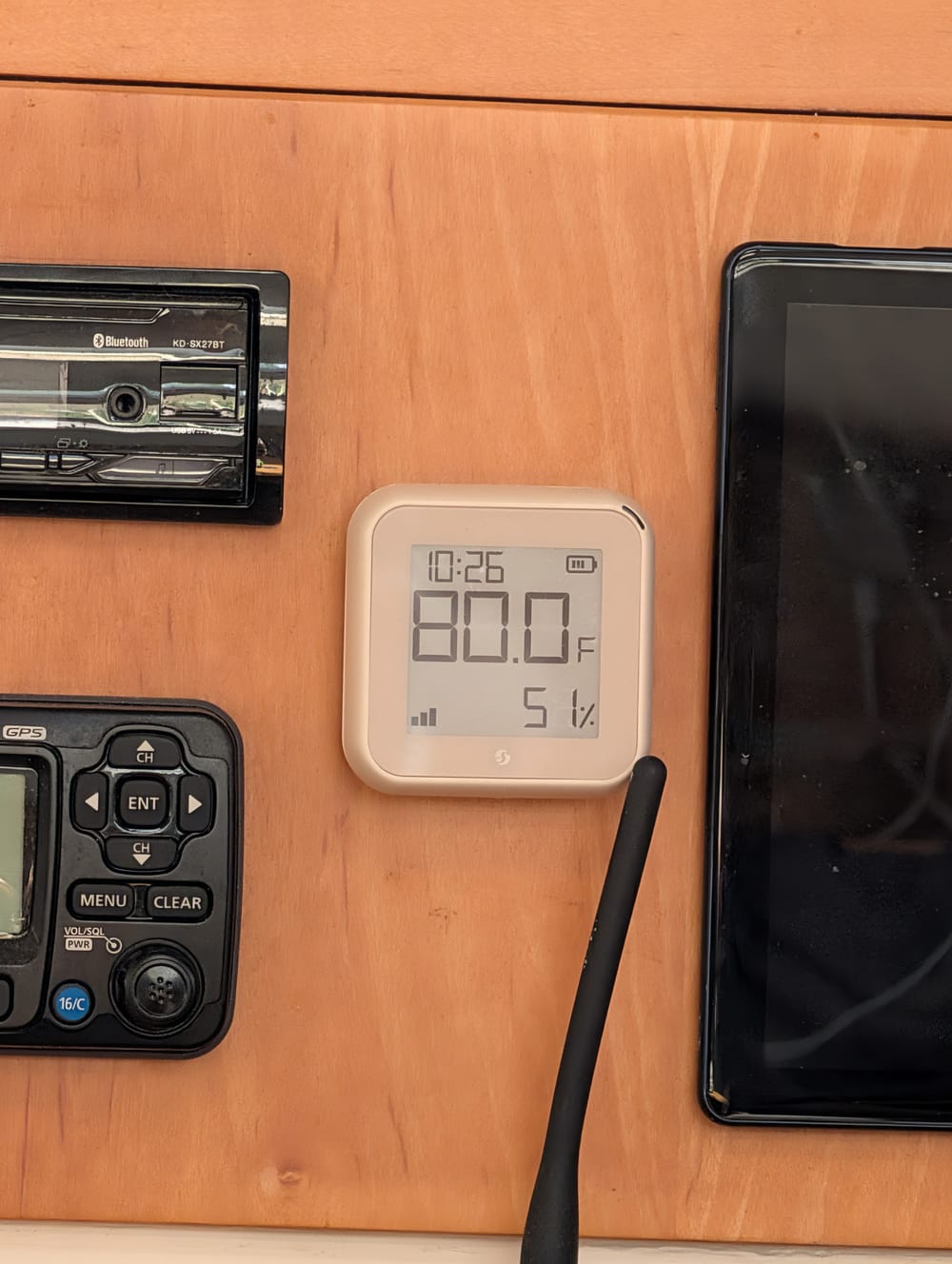
Temperature and humidity sensor with an e-ink display. Battery powered, reports over Wi-Fi. We have these in the engine room, the lazarette, and the main cabin. The engine room sensor triggers a Home Assistant alert if temperature exceeds a threshold — critical for catching overheating before it becomes an emergency.
Shelly Plus Plug S
For shore power monitoring. Tracks energy consumption of any AC device plugged into it. Useful for understanding how much power your battery charger, air conditioning, or water heater actually draws when on shore power.
The 12V DC Question
Most home automation devices expect 110/220V AC. Boats run on 12V or 24V DC. This is where Shelly stands out — the Shelly 1 Mini Gen4 natively supports DC input from 12-48V. No voltage converters, no adapters. Wire it directly to your DC panel.
Important: check the specific model's DC voltage range before buying. Not every Shelly device supports DC, and some older generations only handle AC. The Gen4 Mini is the safe pick for DC systems.
Connecting to Home Assistant
Shelly devices connect to Home Assistant via the native Shelly integration — no MQTT configuration needed. Once they are on your boat's Wi-Fi network, Home Assistant auto-discovers them.
From there, you can:
- Build dashboards showing all your boat systems in one place
- Create automations (lights on at sunset, fans on above 80°F, bilge pump alerts)
- Log historical data — temperature trends, power consumption, switch activity
- Set up notifications via phone, email, or Telegram when something goes wrong
We run Home Assistant on a Raspberry Pi 4 with a Zigbee coordinator for additional sensors. The Pi draws about 3W — negligible on a boat power budget.
Reliability at Sea
The biggest concern with smart home devices on a boat is reliability. If your Wi-Fi router reboots, will your lights stop working?
Shelly handles this well. The physical switch passthrough means lights and relays still work manually even with no Wi-Fi. When the network comes back, the Shelly reconnects automatically. We have had zero issues with Shelly devices failing due to power fluctuations, humidity, or motion — and our boat is in the tropics.
What It Costs
A Shelly 1 Mini Gen4 costs about $12. A marine-rated smart switch from a chandlery costs $80-200 and does less. The entire automation system on our boat — six Shelly relays, three temperature sensors, and a Raspberry Pi running Home Assistant — cost under $200 total.
The Bottom Line
If you want smart automation on a boat or RV without paying marine-industry prices, Shelly plus Home Assistant is the answer. Cheap, reliable, runs on DC, and fully local — no cloud dependency. Start with one Shelly 1 Mini on a light circuit and see how you like it.