You Need a Handheld VHF
Your fixed-mount VHF radio is the primary communication system on your boat. But a handheld VHF is the backup that saves you when the fixed mount fails, when you are in the dinghy, or when you need to communicate from the deck without running below.
Every boat should have at least one handheld VHF aboard. If you are cruising offshore, carry two.
What Actually Matters in a Handheld VHF
Most handheld VHF radios sold today are fine. The feature wars between manufacturers are mostly irrelevant for practical use. Here is what actually matters:
- It must float. You will drop it in the water eventually. A radio that sinks is a radio you no longer have. Non-negotiable.
- Waterproof rating. IPX7 minimum (submersible to 1 meter for 30 minutes). IPX8 is better. JIS7 and JIS8 are the equivalent Japanese ratings — same thing.
- Battery life. 10+ hours of typical use (90/5/5 duty cycle: 90% standby, 5% receive, 5% transmit). Rechargeable with a standard charging cradle, not proprietary nonsense.
- 6 watts transmit power. This is the legal maximum for marine VHF. All decent handhelds hit this. Range is about 3-5 miles depending on conditions and antenna height.
- Channel 16 quick access. One-button access to the emergency/hailing channel. Every marine VHF has this, but verify the button is easy to find by feel in the dark.
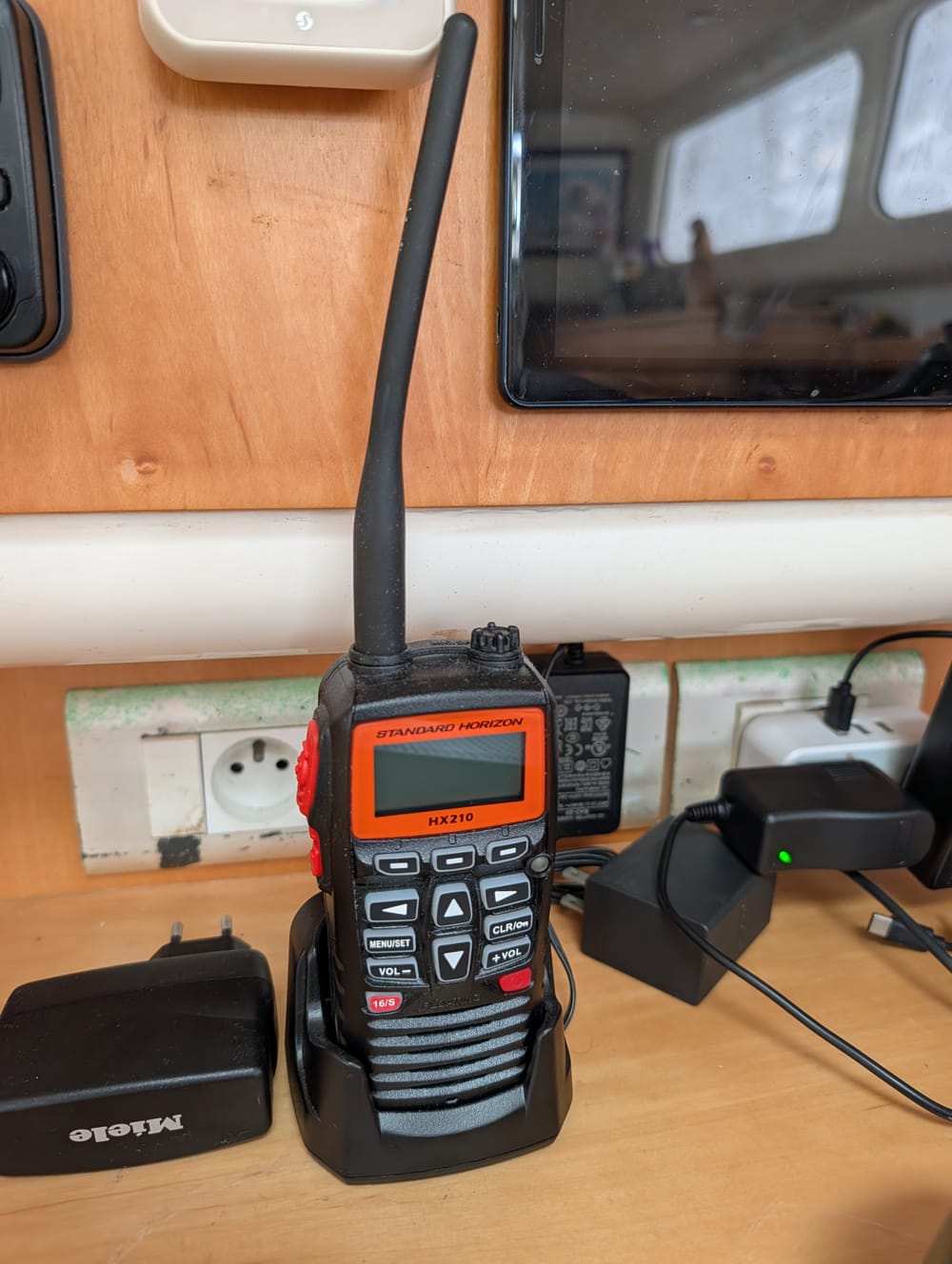
Our Pick: Standard Horizon HX210
We carry the Standard Horizon HX210 aboard. It floats, it is IPX8 rated (submersible beyond 1 meter), the battery lasts about 12 hours of normal use, and it is simple to operate. No menus to navigate in an emergency — everything important is accessible with physical buttons.
The HX210 also has a built-in FM radio, which is a surprisingly useful feature at anchor or on the beach. Not a reason to buy it, but a nice bonus.
At around $80-90, it is not the cheapest handheld VHF, but it is the best value when you factor in the float capability and build quality. Standard Horizon has been making marine radios for decades and the reliability shows.
→ Standard Horizon HX210 on Dupree Products
Runner Up: Icom IC-M25
The Icom IC-M25 is lighter and slimmer than the HX210, which makes it easier to clip to a PFD. It also floats, is IPX7 rated, and has a USB charging port instead of a proprietary cradle — a real advantage if you are cruising and want to charge from any USB source.
The trade-off is a slightly shorter battery life (about 11 hours) and the body feels less rugged than the Standard Horizon. Both are good radios. The Icom wins on portability, the Standard Horizon wins on durability.
What About DSC?
Digital Selective Calling (DSC) lets you send a digital distress signal with your GPS position at the push of a button. On a fixed-mount radio, DSC is essential and you should absolutely have it configured with an MMSI number.
On a handheld, DSC is a nice-to-have but not critical. The handhelds with DSC (like the Standard Horizon HX890) cost $200+ and are larger and heavier. Your fixed mount should be your primary DSC radio. The handheld is your backup voice radio.
Tips for Carrying a Handheld VHF
- Keep it in a waterproof bag with a lanyard when in the dinghy. Even floating radios are hard to spot in waves.
- Program your local channels before you need them — harbor control, marina, bridge tenders, tow services.
- Test the battery monthly. A dead handheld in the ditch bag is worse than no handheld at all.
- Carry a spare battery pack if you are going offshore. Cold weather kills battery life.
The Bottom Line
Buy the Standard Horizon HX210 if you want the most reliable, durable floating handheld VHF for under $100. Buy the Icom IC-M25 if weight and USB charging matter more to you. Either way, put one in your ditch bag and one in the cockpit locker. This is not gear to cheap out on.