What It Does
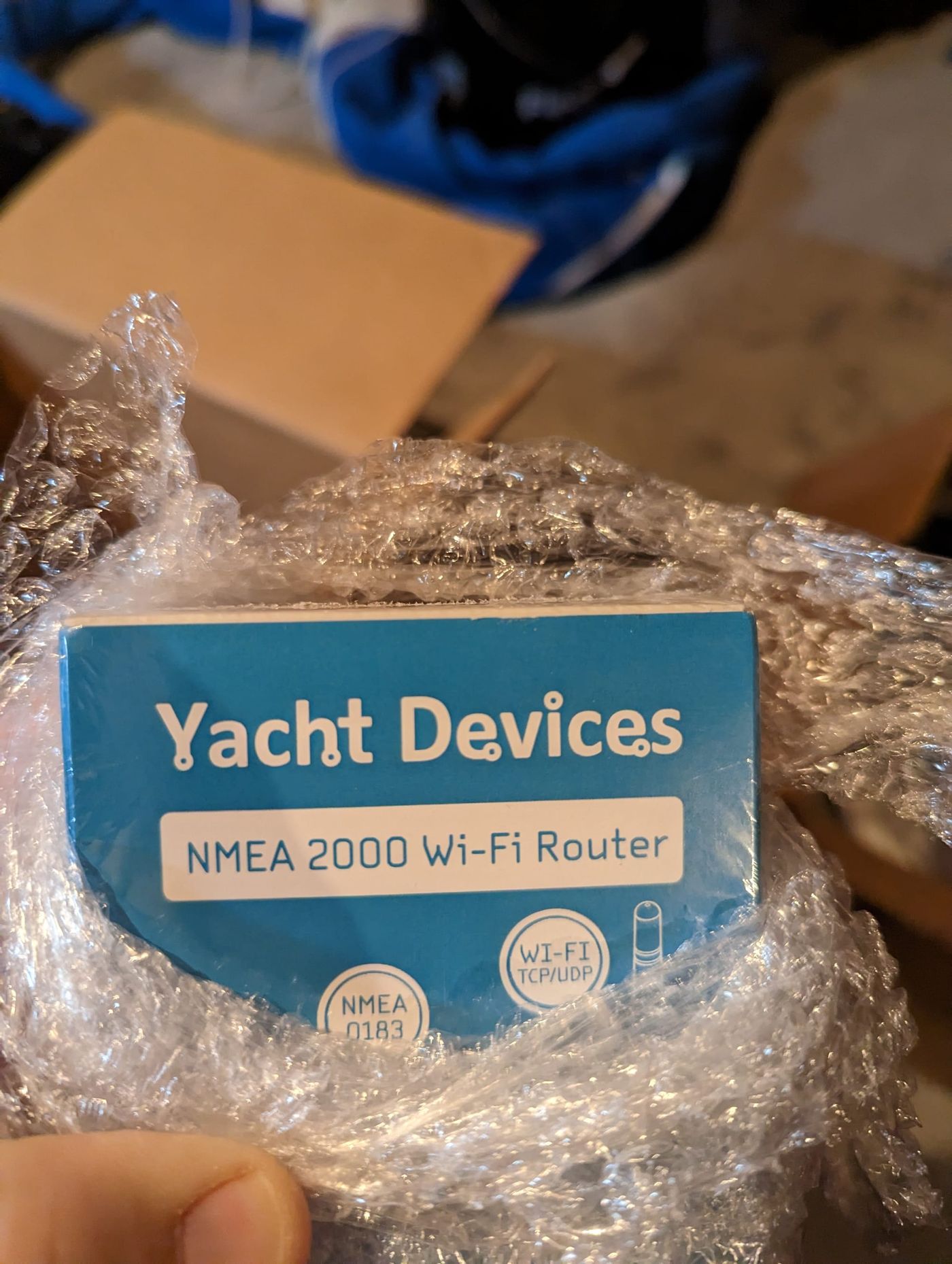
The Yacht Devices YDNR-02 is a NMEA 2000 Wi-Fi router. It plugs into your N2K backbone and serves up your boat's data — depth, wind, GPS, AIS, engine, tank levels, anything on the bus — to any device on your Wi-Fi network.
Open Navionics on your phone. Open iNavX, Aqua Map, TimeZero, or any chart app that speaks NMEA 0183 or NMEA 2000 over Wi-Fi. Suddenly your phone shows everything your MFD does. No cables, no paid cloud service, no monthly fee. Just a $250 box that does one job and does it well.
We've had a YDNR-02 on our boat for three years.
Why It Just Works
The pitch is "plug it into your NMEA 2000 backbone and it works." That's actually true.
Setup is a web page. Plug it into the N2K backbone, give it power, and connect it to your boat's existing Wi-Fi network. Browse to its IP from any device on that network and configure SSID join, output protocols, and which sentences to publish. Save. Done. No app, no account, no firmware update flow that requires their cloud. The web interface is functional, fast, and built like 2010 — which on a boat is a feature, not a bug. It loads on a flaky Starlink connection or no connection at all.
It doesn't drift. In three years, we've rebooted it maybe four times — all because we power-cycled the whole nav station for unrelated work. It hasn't lost configuration. It hasn't required a firmware patch to keep working. It hasn't gotten slower over time.
It just shows up. Every time we step aboard, every device that's ever connected to the boat network can find the YDNR-02 at its known IP and start receiving N2K data. We have never had to debug "why isn't my chart app showing depth?" in three years.
This is what good marine electronics feel like: present, reliable, invisible.
What We Use It For
- Backup chart plotter on a phone when we want to check a route or anchorage from the cockpit without going to the helm
- Crew can see speed, wind, and depth from anywhere on the boat
- Signal K integration — our Raspberry Pi pulls the YDNR-02 stream and republishes everything in Signal K format alongside the rest of our data
- Engine monitoring — fuel rate, RPM, oil pressure visible on a phone in real time when we're underway
- AIS targets on a tablet at the nav station as a second screen
If you have a Furuno or Garmin or Raymarine MFD, you do not need this — your MFD shows everything already. What the YDNR-02 buys you is ubiquity. Every device on the boat becomes a screen for boat data.
YDNR-02 vs YDWG-02 vs the Rest
Yacht Devices has a confusing product matrix. Here's the short version:
| Model | What It Is |
|---|---|
| YDNR-02 | NMEA 2000 input. Can run as Wi-Fi router (own network) or join an existing network. The flexible one. |
| YDWG-02 | NMEA 2000 input. Joins an existing Wi-Fi network only. Simpler. |
| YDWN-02 | NMEA 0183 input + own Wi-Fi |
| YDWR-02 | NMEA 0183 input + joins existing Wi-Fi |
| YDEN-02 | NMEA 2000 input + Ethernet output |
We have ours running as a client on the existing onboard Wi-Fi network — every device on the boat is already on that network, so the data just shows up wherever we want it. The YDNR-02 was the right pick because it is flexible: if the main Wi-Fi ever drops, we can flip it to AP mode and still get data on a phone or tablet directly. That fallback isn't a feature we've needed yet, but it is why we picked the router model over the simpler YDWG.
The Company Question
This is the honest part of the review. Yacht Devices is opaque about its origins.
Their listed "Yacht Devices Ltd." business address is a mail-forwarding center in Vancouver, BC. The team page lists employees with Russian names — one bio mentions crossing the Atlantic in 2013 as first mate on s/v Mur Mur. Marine forums have speculated the engineering is in Russia or Eastern Europe; the company hasn't said either way.
We're not raising a security flag here. The YDNR-02 doesn't phone home (we've watched its traffic). It doesn't need cloud accounts. Firmware updates are optional and pulled manually. If you are security-conscious, it is actually one of the better devices to put on a boat — it just sits on its local network and does its job.
But if knowing where your gear comes from matters to you, be aware that the answer here is "we don't really know." Some buyers won't care. Some will. We don't, but we noted it.
The product itself is excellent. That's the bottom line.
If You Want a Western-Distributed Alternative
If the Yacht Devices opacity is a dealbreaker, the closest equivalent is the Digital Yacht NavLink 2 — same job, NMEA 2000 to Wi-Fi, available through Western marine distributors. We haven't run one, but Digital Yacht is a UK-based marine electronics company with a clear corporate trail and a long track record. Slightly different feature set, slightly different price, but in the same ballpark for capability.
→ Digital Yacht NavLink 2 on Dupree Products — $245.99
What We'd Change
Nothing major. A few minor wishes:
- Better diagnostics on the web page. It would be nice to see a real-time count of N2K messages flowing through, not just the configured output streams.
- Modern Wi-Fi. It is 2.4GHz only, single-band. Fine for marine instrument data — which is low-bandwidth — but the network feels dated next to a Starlink or modern access point.
- Status LED that means something. The single status LED is essentially "I'm on" with no further info. A second LED for "data flowing" would help debug installs.
These are quibbles. The device does what it claims and does it for years.
The Bottom Line
Three years in, the YDNR-02 has been a textbook example of marine gear done right: install once, configure once, forget about it. If you want NMEA 2000 data on every device on your boat — phones, tablets, laptops, third-party software — and you don't want a subscription or a cloud account or a fragile setup, this is the box.
The company's opacity is the only thing keeping this from being a no-reservations recommendation. We'd buy it again knowing what we know.
→ Yacht Devices YDNR-02 (manufacturer's site)