How to Use This
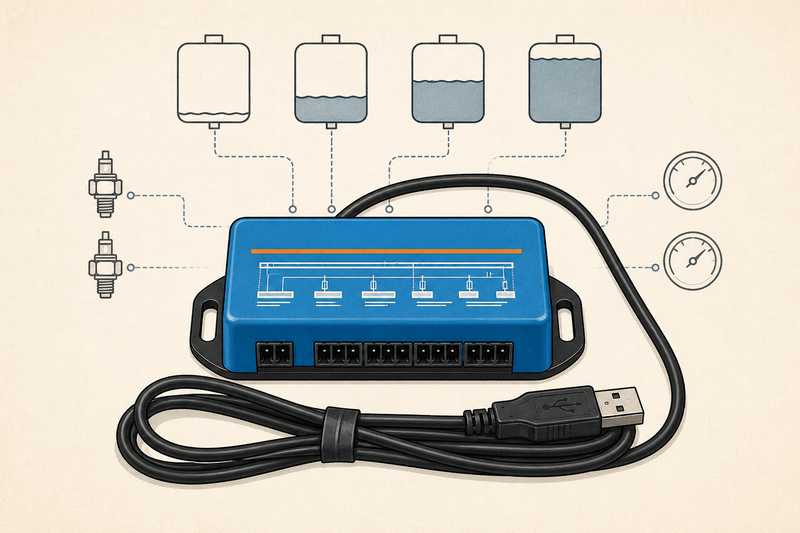
Start with daily Wh consumption. That's the input that matters most. Add up your fridge, lights, electronics, watermaker, and anything else that runs from the bank in a typical 24-hour day. If you don't know — start measuring with a battery monitor (the Victron SmartShunt is what we use on our boat).
Days of autonomy is judgment. Most cruisers size for 1–3 days. Off-grid liveaboards 3–5. Belt-and-suspenders 5–7. The bigger the bank, the more it costs and the longer it takes to recharge — but the more cushion you have for cloudy weeks.
Pick the right chemistry. LiFePO4 is the right answer for almost any new install — 80% usable vs 50% for lead-acid means a 100Ah lithium bank does the same job as a 200Ah lead-acid bank, weighs half as much, and lasts 3–5× longer. The price gap has narrowed significantly. Lead-acid still wins on cold-weather use (LiFePO4 won't charge below ~32°F without internal heating) and absolute lowest upfront cost.
The reserve multiplier matters more than people think. Sizing exactly to your daily need leaves zero margin for cloudy weeks, surprise loads, or aging cells. 20% reserve is the practical default. 50% is paranoid but cheap insurance on a system you live with for years.
What This Doesn't Account For
A few things this calculator simplifies that you should think about separately:
Temperature derating. All batteries lose capacity in cold. LiFePO4 drops about 10–20% at freezing. Lead-acid drops more. If you're cold-weather cruising or storing the boat in winter, size up.
Aging. Both lithium and lead-acid lose capacity over the bank's life. Plan to replace lead-acid every 3–7 years, lithium every 8–15 years. The numbers above are for a new bank.
Peak loads. A windlass or thruster pulls 100–300A momentarily. The bank has to deliver that without sagging out of spec. Most modern lithium and AGM banks handle this, but flooded lead-acid struggles with high-current pulses.
Inverter efficiency. If you're powering AC loads through an inverter, the inverter itself is 85–95% efficient. The Wh you measure on the AC side gets a 5–15% bump on the DC side. The 95% round-trip efficiency for lithium in this calculator approximates this for typical use.
Common Mistakes
Sizing for "100Ah lithium = 100Ah lead-acid." It doesn't. 100Ah lithium gives you 80Ah usable. 100Ah lead-acid gives you 50Ah usable. To replace a 200Ah lead-acid bank with lithium, you only need about 125Ah of lithium for the same usable capacity.
Forgetting the inverter and watermaker. The big draws are easy to forget. A watermaker can pull 30A while running, and even an hour a day adds up to 360 Wh. Inverter standby pulls 10–30W constantly even with no AC load.
Not accounting for charge time. A bigger bank takes longer to recharge. If you have 2,000 Wh of solar but a 10,000 Wh bank, you'll never fully recharge on a sunny day.
Going lead-acid because lithium "is too expensive." Run the math over 10 years. Lithium has been cheaper in total cost of ownership for at least 5 years now.
Where to Buy
Cells, BMS, and complete LiFePO4 systems for marine and RV builds:
→ Battery Chargers and Monitoring on Dupree Products
Cross-References
- Best Marine Battery Monitor: Victron SmartShunt 500A Review — measure your actual consumption before sizing
- Marine Wire Gauge Calculator — size the cables to your bank
- Marine Fuse Sizing Calculator — required within 7 inches of the battery
- RV Battery Monitoring: What Actually Works
Spotted something off? Email braden@goodkit.io. We use this on our boat.
- Compare battery monitoring — check what a monitor measures and what it estimates
- SmartShunt 500A — a monitoring option, not a battery-size recommendation
- Plan the monitor installation — connections, cable and optional GX integration