The Victron GX Tank 140 solved a very specific problem on our boat: we wanted pressure-based tank sensors to become part of the same monitoring system as the rest of our Victron equipment.
We installed it in 2023 as the traditional resistive float senders aboard began dying. Direct replacements were expensive and difficult to install, so we started using pressure senders for the remaining tanks instead. Our transitional system now combines pressure senders connected through the GX Tank 140 with surviving resistive senders connected directly to the Cerbo GX. The Cerbo brings both types together, displays all the tanks in one place, sends their levels to Victron's VRM portal, and eventually made the data available to Home Assistant.
That is what makes the GX Tank 140 valuable. It does not make a tank sensor more accurate by itself, and it is not a standalone gauge. It turns as many as four compatible analog sensors into data the rest of a Victron system can use. For an installation that needs those inputs, it is GoodKit Approved.
What the GX Tank 140 actually supports
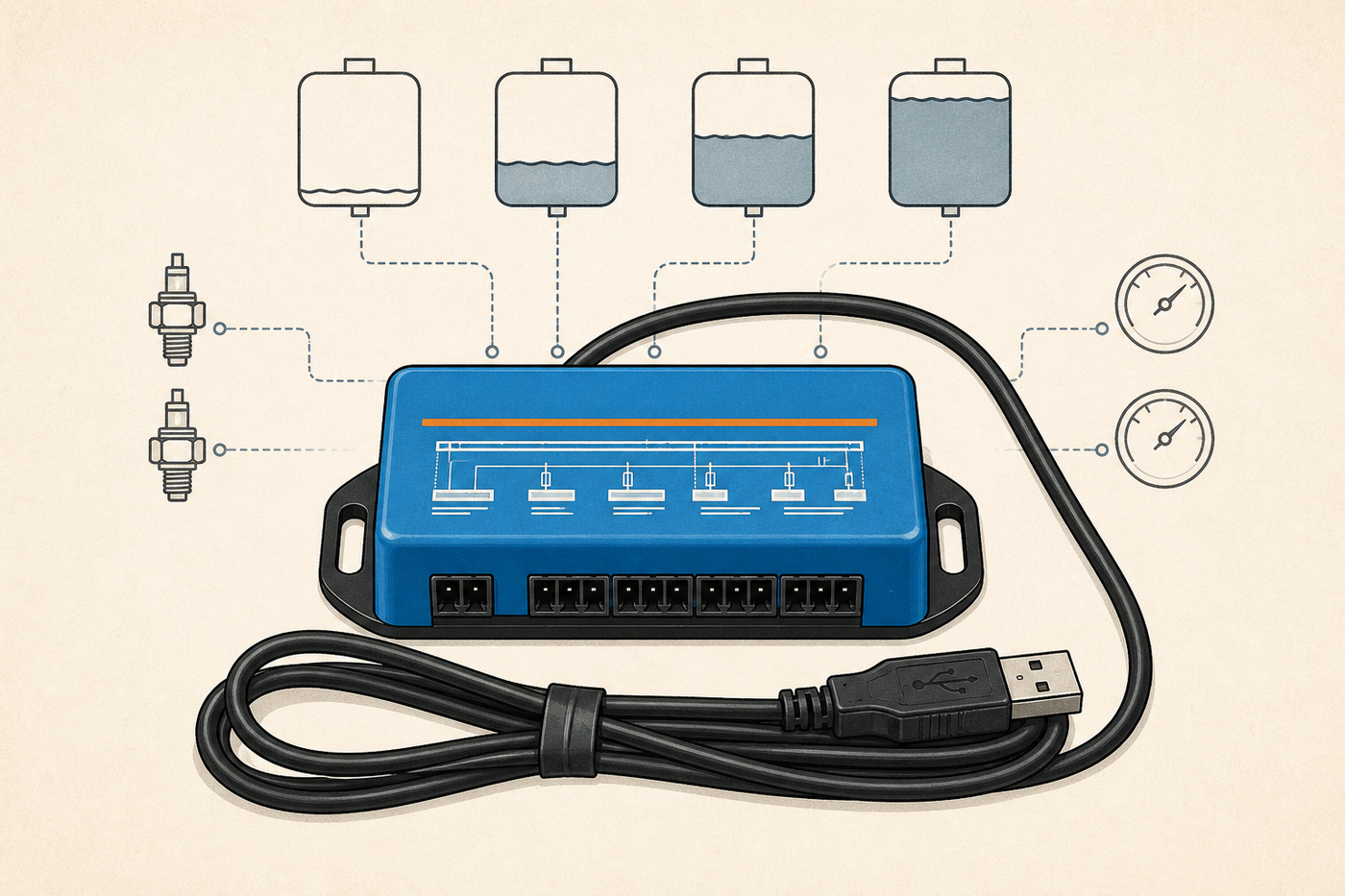
The name makes the device sound more universal than it is. The GX Tank 140 accepts up to four sensors that produce either a 4–20 mA current signal or a 0–10 V voltage signal. It can also be configured for sensors that use only part of that voltage range, such as 0–5 V.
It does not directly accept traditional passive resistive tank senders. Those belong on the Cerbo GX's four built-in resistive tank inputs or require a separate resistance-to-voltage or resistance-to-current converter.
That distinction matters when planning a system:
- Our pressure-output tank sensors connect to the GX Tank 140.
- Our surviving conventional resistive tank senders connect directly to the Cerbo GX until they need replacement.
- The Cerbo displays and distributes both sets as one collection of tank data.
The GX Tank 140 connects to the Cerbo through a fixed USB cable. The USB connection handles communication and powers the module itself. Depending on which channels and sensors are used, sensor excitation can come from the module's built-in 24 V supply or an external power input.
Pressure senders were the practical replacement
We did not choose pressure sensing merely to add more tanks. The original resistive float senders were dying, and suitable replacements were both expensive and difficult to install. Pressure senders offered a considerably less expensive and easier way to bring those tanks back online as the old senders failed.
A pressure sender measures the hydrostatic pressure created by the liquid above it. Once the sender's output range and the tank dimensions are configured, the Cerbo can translate that signal into a useful level and volume.
Pressure sensing also avoids some of the mechanical complications of installing a float-style sender through the top of a tank. The best approach still depends on the tank, available fittings, fluid type, sender construction, and access. The important point is that the GX Tank 140 gave us a practical way to use inexpensive industrial-style analog sensors rather than limiting the system to a narrow list of dedicated marine tank gauges.
The device can mix current-output and voltage-output sensors across its four channels. That flexibility is especially helpful on an existing boat, where replacing every sender simply to make the system uniform would add cost without necessarily improving the result.
Installation is mostly sensor wiring plus USB
The module itself is straightforward. It is a small blue enclosure with mounting tabs, four removable sensor terminal blocks, an external-power terminal, and a permanently attached USB lead. Once the sensors are wired and the USB cable is connected to the Cerbo, the GX Tank appears in the GX device list.
The sensor wiring deserves more attention than the USB connection. A pressure sender must have the correct supply, ground, and signal arrangement for its output type. Channels 1 and 2 use the external input supply for sensor excitation, while channels 3 and 4 can provide the GX Tank's integrated 24 V supply. That makes the last two channels particularly convenient for compatible 4–20 mA pressure senders.
We would choose the channels, power arrangement, and wire routing before mounting the enclosure. The device simplifies sensor integration, but it cannot compensate for an incompatible sender, incorrect excitation voltage, a poor ground, or a signal wire routed carelessly through a noisy machinery space.
Pressure-sensor calibration was easy
We calibrated the pressure sensors through the Cerbo interface. That process was straightforward: identify the channel, choose the tank type and sensor mode, set the useful input range, and define the tank's capacity and shape.
The GX Tank includes configurable averaging from one to 60 seconds. A tank on a moving boat is rarely level or still, so an instantaneous sensor reading can bounce as the liquid moves. Averaging slows the display response slightly but produces a level that is much more useful than watching every small pressure fluctuation.
Victron also allows the lower and upper input limits to be adjusted. That is useful when a nominal 0–10 V sensor uses only 0–5 V, or when the empty and full readings do not align perfectly with the theoretical endpoints.
The traditional resistive senders required more trial and error to calibrate, but that happened on the Cerbo's resistive inputs—not inside the GX Tank 140. Existing resistive senders may work in reverse, use different resistance ranges, or behave nonlinearly because of tank shape and float-arm geometry. It would be inaccurate to blame that work on the GX Tank.
The real benefit is putting every tank online
Before this installation, a tank level could be useful only at a physical gauge on the wall. Someone had to be standing in front of it, and the reading could not participate in any other monitoring or automation.
Once the GX Tank and Cerbo were configured, all of our tanks became part of the boat's data system. We can see them in the GX interface alongside battery state, charging, solar production, inverter status, and other onboard information. The same levels can be viewed remotely through VRM rather than only from inside the boat.
Eventually, we shared the tank data with Home Assistant. Our boat and RV Home Assistant setup guide covers the broader architecture. Once connected, the tanks can participate in one combined dashboard, low-level warnings, history graphs, and automations that use tank state alongside electrical and environmental data.
We do not need an elaborate automation to justify the system. Simply being able to check all tank levels from the same display—or remotely—is already a substantial improvement over a collection of unrelated wall gauges.
Mixed sensors are a strength, not a compromise
Our installation demonstrates why the GX ecosystem is useful. We did not have to force every tank onto the same sender technology.
The pressure sensors use the GX Tank 140 because their current or voltage signals match what it is designed to read. The surviving resistive senders remain on the Cerbo because it already has the appropriate resistance inputs. As those float senders die, we can replace them with pressure senders without redesigning the monitoring system. From the user's perspective, the different electrical interfaces disappear after configuration: the tanks appear together in the same software.
That is a much better result than prematurely replacing the resistive senders that still work or repeatedly buying costly, difficult-to-install float replacements simply to preserve the original design.
Who does not need a GX Tank 140?
The GX Tank 140 is not a universal recommendation. It makes sense only when three conditions are true:
- You already have—or plan to install—a compatible Victron GX device such as a Cerbo GX.
- You have pressure or other tank senders that output 4–20 mA or 0–10 V.
- You want those readings integrated into the GX, VRM, NMEA 2000, or another connected system.
If all of your tanks already use compatible resistive senders and the Cerbo's four inputs are sufficient, the GX Tank may add nothing. If you use wireless Bluetooth sensors, those may integrate through a different path; our tank-monitoring sensor guide covers several of those alternatives. If you only need one local gauge and have no GX system, a standalone display may be simpler and cheaper.
That conditional usefulness is why our verdict is “GoodKit Approved if you need it.” Within its intended role, the GX Tank 140 is inexpensive, flexible, and unusually easy to integrate. Outside that role, it is an unnecessary blue box.
The bottom line
The Victron GX Tank 140 gave us a cost-effective migration path as the boat's original resistive float senders began to fail. Instead of installing expensive and difficult replacements, we can connect pressure-based sensors to the Cerbo GX through the GX Tank. Installation was straightforward, calibration through the Cerbo was easy, and the resulting tank levels now live alongside the rest of our boat data instead of remaining trapped on a wall gauge.
The resistive senders that have not yet failed remain connected directly to the Cerbo and required more calibration trial and error. That mixed arrangement is not a workaround; it is one of the system's advantages. Each sender uses the interface designed for it, while the Cerbo makes them all look like one coherent monitoring system during the transition.
If you have compatible 4–20 mA or 0–10 V sensors and already use a Victron GX device, the GX Tank 140 is GoodKit Approved. If you only have resistive senders, start with the Cerbo's built-in inputs instead.
- Provides a practical migration path as expensive resistive float senders fail
- Makes up to four pressure or voltage-output tank sensors available to the Cerbo
- Pressure senders were less expensive and easier to install than replacement float senders
- Pressure-sensor calibration through the Cerbo was straightforward
- Supports both 4–20 mA and 0–10 V sensors in the same module
- Configurable averaging calms readings as liquid moves aboard
- Puts tank levels into GX, VRM and Home Assistant instead of isolating them on a wall gauge
- Works cleanly alongside surviving resistive senders connected directly to the Cerbo
- Does not directly support passive resistive tank senders
- Requires a compatible Victron GX device
- Correct sensor type, excitation voltage and channel wiring still matter
- Some channels require an external sensor power supply
- Unnecessary if the Cerbo's resistive inputs or wireless sensors already cover every tank
Where to buy and learn more
Disclosure: Dupree Products is affiliated with GoodKit's publisher. This review is based on our own onboard installation, in use since 2023.