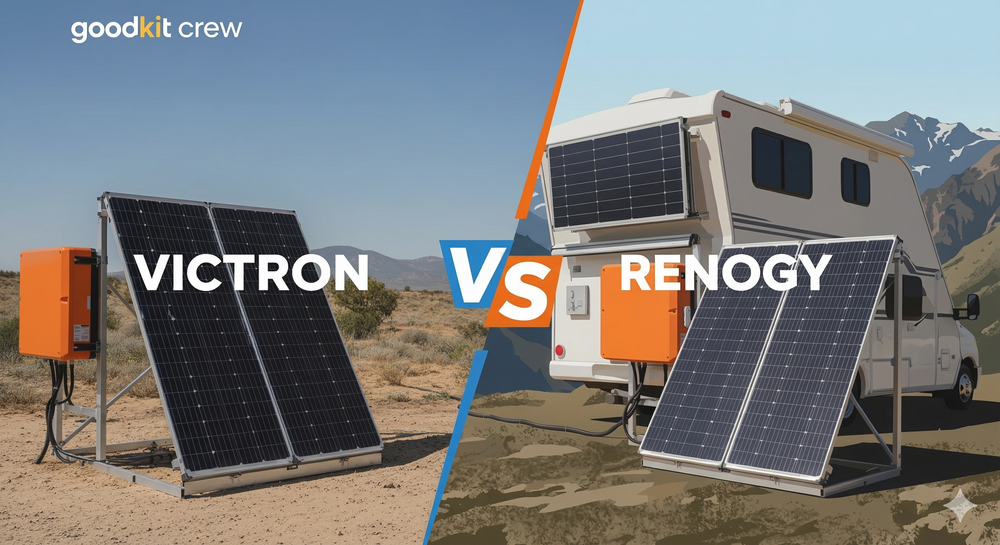
If you're wiring solar into an RV or boat, you've already landed on the two brands that dominate the space: Victron Energy and Renogy. They show up in every forum thread, every YouTube build, and every Amazon search for MPPT controllers.
So which one do you actually buy?
The Short Answer
Victron is the better product. Renogy is the cheaper product. Both work. The right choice depends on how you use your rig, how much you want to monitor, and whether you plan to expand later.
Here's the full breakdown.
Build Quality
Victron charge controllers use aluminum housings with passive cooling — no fans, no moving parts, nothing to wear out or clog with dust. They run at roughly 98% peak efficiency and feel like something pulled from industrial equipment. Because there's no fan, they're silent, and there's one less component that can fail in a hot engine bay or a damp lazarette.
Renogy controllers use plastic housings with active fan cooling. Efficiency lands around 96-97%, which is still good. The build quality is adequate — these aren't flimsy products — but they don't feel premium. The fan is a potential failure point, and plastic doesn't shed heat or resist UV degradation the way aluminum does.
In a climate-controlled house, this distinction barely matters. In an RV roof compartment hitting 140 degrees in July, or a sailboat locker soaked with salt air, Victron's construction earns its price difference over time.
MPPT Performance
Both brands use Maximum Power Point Tracking, but the implementation differs significantly.
Victron's MPPT algorithm tracks fast. When a cloud passes, when a tree shadow slides across one panel, when you're driving through dappled light on a tree-lined road — the Victron controller re-finds the optimal power point quickly. This matters because partial shade is the norm for most RV and boat installations, not the exception.
Renogy's tracking is slower. In steady, full sun, it performs well. But in dynamic conditions — passing clouds, partial shade, panels at imperfect angles — it lags behind. It still harvests power, just less of it.
The real-world difference is roughly 5-15% more energy harvested from a Victron controller in imperfect conditions. On a cloudy week when you're relying on every watt, that gap matters.
Software and Monitoring
This is where the gap becomes a canyon.
Victron ships every SmartSolar controller with built-in Bluetooth. Open VictronConnect on your phone and you get real-time data: panel voltage, charge current, battery state, yield history, error codes. No extra hardware needed.
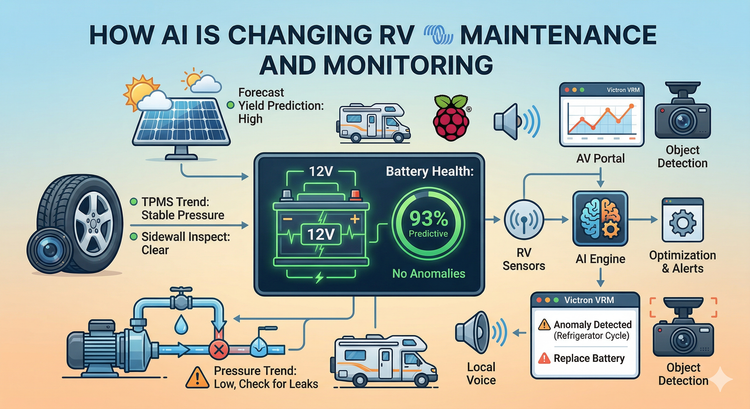
Add a Cerbo GX and you unlock the full VRM (Victron Remote Management) portal — a cloud dashboard that lets you monitor your entire electrical system from anywhere with an internet connection. You can check your battery state of charge from a restaurant. You can see that your fridge tripped a breaker while you're at work. You can view 30-day yield graphs and spot trends.
Renogy offers a basic app and the DC Home module for local monitoring. It shows you the essentials — voltage, current, basic history. But there's no real cloud platform, no remote access, and the interface feels like an afterthought compared to VictronConnect.
If monitoring matters to you — and for full-timers or anyone with a lithium bank, it should — Victron's software ecosystem is the single biggest reason to choose it.
Integration and Ecosystem
Victron products talk to each other. A SmartSolar controller connects to a SmartShunt battery monitor over VE.Direct. Add a Victron inverter/charger and a Cerbo GX, and every component reports to one unified dashboard. Battery voltage, solar yield, AC loads, shore power status — all in one place, all logged, all accessible remotely.
Renogy products are mostly standalone. The charge controller does its job. The battery monitor does its job. But they don't share data in a meaningful way. There's no single pane of glass for your whole system.
If you want one dashboard that shows everything — and you will, once you've lived with solar for a few months — Victron is the only real option in this price range.
Panels
Here's where Renogy fights back: their panels are genuinely good and significantly cheaper than Victron's.
A Renogy 200W panel kit runs around $200. A comparable Victron panel setup costs $350 or more. The efficiency difference between panels at this level is minimal. Both use monocrystalline cells. Both have similar temperature coefficients. Both will bolt to your roof and make electricity for 20+ years.
Panel quality matters less than controller quality. The controller is doing the hard work of converting variable panel voltage into the correct charge profile for your battery. A great controller paired with budget panels outperforms a budget controller paired with premium panels.
This opens up the best strategy for most people: mix and match.
Pricing Comparison
Here's what a typical system costs from each brand:
| Component | Renogy | Victron |
|---|---|---|
| 200W panel kit | ~$200 | ~$350 |
| 30A MPPT controller | ~$100 | ~$180 |
| Battery monitor | ~$50 | ~$100 |
| Full 400W system | ~$500-700 | ~$800-1200 |
Victron costs roughly 50-70% more across the board. For a basic weekend-warrior setup, that's money you might not need to spend. For a full-time rig, it's money that pays for itself in reliability, monitoring, and expandability.
Specific products worth looking at:
- Renogy 100W Monocrystalline Panel — solid budget panel, easy to find
- Renogy Rover 30A MPPT Controller — best value if you're staying in the Renogy ecosystem
- Victron SmartSolar MPPT 100/30 — the sweet spot for systems up to 400W
- Victron SmartSolar MPPT 150/60 — for larger systems, higher voltage strings, or future expansion
- Victron SmartShunt — the best battery monitor under $150, pairs perfectly with VictronConnect
Warranty
Victron offers a 5-year warranty across their product line. That's notable confidence in hardware that lives in harsh environments.
Renogy's standard warranty is 1-2 years on most products, with some newer items stretching to 5 years. Read the fine print — coverage varies by product and sometimes by where you bought it.
For equipment mounted on a roof that bakes in summer and freezes in winter, warranty length matters. Victron's 5-year coverage isn't just marketing; it reflects how long they expect their hardware to last.
Who Should Buy Renogy
Renogy makes sense when:
- Budget is the primary concern. A full Renogy system costs 40-50% less than the Victron equivalent. That's real money.
- Your setup is simple. Panels, controller, battery, done. No need for networked monitoring or remote access.
- You're a weekend or seasonal user. If the RV sits in storage most of the year, you don't need Victron-tier hardware.
- It's your first solar setup. If you're not sure you'll stick with RV life or expand the system, Renogy lets you get started without a major investment.
Who Should Buy Victron
Victron is worth the premium when:
- You live in your rig full-time. Reliability and monitoring aren't luxuries — they're necessities.
- You want remote monitoring. Checking your system from your phone while you're away from the rig is genuinely useful.
- You're running a lithium battery bank. Lithium batteries need accurate state-of-charge monitoring and precise charge profiles. Victron delivers both.
- You plan to expand. Starting with a 200W system but thinking about 600W next year? Victron's ecosystem scales without replacing components.
- You're in a marine environment. Salt air, humidity, and heat punish cheap hardware. Victron's aluminum construction and passive cooling handle it.
- You want one ecosystem. Solar, batteries, inverter, shore power — all visible in one app, one dashboard, one system.
The Best Combo: Our Pick
For most serious RV and boat solar setups, the best value isn't all-Victron or all-Renogy. It's this:
Renogy panels + Victron SmartSolar MPPT controller + Victron SmartShunt
You get Renogy's affordable, reliable panels doing the simple job of converting sunlight to DC power. Then the Victron controller handles the complex work — fast MPPT tracking, precise battery charging, Bluetooth monitoring. The SmartShunt gives you accurate battery state-of-charge data. And the whole thing talks through VictronConnect on your phone.
This combo saves you $100-200 over a full Victron system while keeping the components that matter most at the premium level. It's the setup we'd recommend to anyone who's past the "just experimenting" phase and wants solar they can depend on.
Bottom Line
Renogy gets you running for less money. Victron keeps you running with more confidence. If you can afford Victron's controllers and monitoring — even if you pair them with Renogy panels — that's the move. If budget is tight, Renogy will still keep your batteries charged and your fridge cold.
Either way, you're ahead of the person still running a generator.