RV Solar System Sizing: How to Calculate What You Need
Stop Guessing, Start Calculating
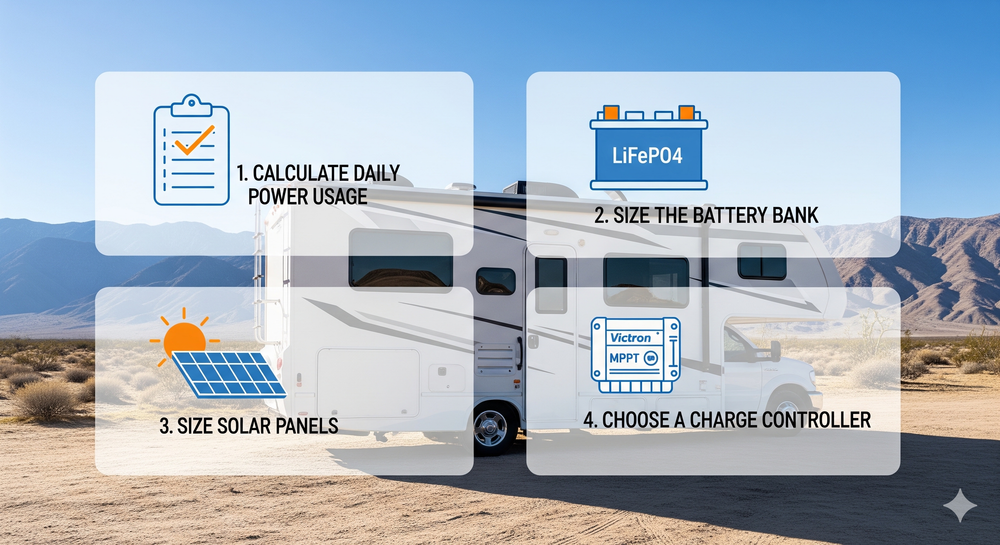
The most common mistake in RV solar is buying panels first and figuring out the math later. Solar sizing is straightforward once you understand the four steps: calculate your load, size your battery, size your panels, and choose a charge controller. Work through these in order and you will end up with a system that actually meets your needs.
Step 1: Calculate Your Daily Power Usage
List every electrical device you plan to run on battery power. Multiply the wattage by the hours of daily use to get watt-hours (Wh). Here are common RV loads:
| Device | Watts | Hours/Day | Wh/Day |
|---|---|---|---|
| LED lights (5 fixtures) | 50 | 5 | 250 |
| Residential fridge | 150 | 8 (cycling) | 1200 |
| Laptop charger | 65 | 4 | 260 |
| Phone charger (2x) | 20 | 3 | 60 |
| Vent fans (2x) | 30 | 8 | 240 |
| Water pump | 60 | 0.5 | 30 |
| TV/streaming | 80 | 3 | 240 |
Example total: ~2,280 Wh/day (2.28 kWh)
Add 15% for inverter losses and wiring inefficiency. Adjusted total: ~2,620 Wh/day.
Step 2: Size Your Battery Bank
Your battery bank needs to store enough energy to cover your daily usage with a safety margin. The multiplier depends on battery chemistry:
- Lead-acid (AGM/flooded): Multiply daily usage by 2x. Lead-acid batteries should not be discharged below 50% regularly. So 2,620 Wh x 2 = 5,240 Wh = ~440 Ah at 12V.
- LiFePO4 (lithium): Multiply daily usage by 1.25x. LiFePO4 can be discharged to 80-90% depth safely. So 2,620 Wh x 1.25 = 3,275 Wh = ~273 Ah at 12V.
LiFePO4 costs more upfront but gives you more usable capacity per pound, more charge cycles, and a flat discharge curve. For full-time RV use, LiFePO4 pays for itself within 2-3 years.
Step 3: Size Your Solar Panels
Solar panels need to replace the energy you use each day. The calculation depends on your location and season.
- Peak sun hours: Use 4-5 hours for the southern US, 3-4 for the north, 5-6 for the desert southwest. These are averages; winter is lower, summer is higher.
- Panel efficiency: A 100W panel produces roughly 80W in real-world conditions (heat, angle, dust).
- Charge controller losses: Budget 10-15% loss through the charge controller.
Formula: Daily Wh needed / (sun hours x panel efficiency x controller efficiency) = total panel watts needed.
Example: 2,620 Wh / (4.5 hours x 0.80 x 0.88) = ~828W of panels. Round up to 800-1000W for margin.
Step 4: Choose a Charge Controller
The charge controller sits between your panels and batteries. Two types:
PWM (Pulse Width Modulation)
- Simple, cheap ($20-50)
- Works well when panel voltage closely matches battery voltage
- Wastes energy when panel voltage is much higher than battery voltage
- Fine for small systems under 200W
MPPT (Maximum Power Point Tracking)
- More expensive ($100-400)
- Converts excess panel voltage to additional current
- 10-30% more efficient than PWM, especially in cold weather or with higher voltage panels
- Worth it for any system over 200W
MPPT controllers are sized by input voltage and output current. Make sure your controller can handle your panel array voltage and your battery bank charge current.
Recommended Builds by Budget
Budget Tier (~$500)
- Renogy 200W panel kit with PWM controller
- 100Ah AGM battery
- Good for: weekend camping, minimal loads, charging devices
Mid Tier (~$1,500)
- 400W of panels (2x 200W rigid or flexible)
- Victron SmartSolar MPPT 100/30
- 200Ah LiFePO4 battery
- Good for: extended boondocking, running a fridge and electronics
Premium Tier (~$3,000+)
- 600W+ of panels
- Victron SmartSolar MPPT 150/60
- 400Ah LiFePO4 battery bank
- 3000W inverter/charger
- Good for: full-time living, residential fridge, microwave, A/C assist
Common Mistakes
- Undersizing batteries: More panels without enough battery storage means wasted solar production.
- Ignoring inverter losses: A 2000W inverter running at 20% load is less efficient than a 1000W inverter at 40% load.
- Shade: One shaded cell can reduce an entire panel string's output by 50-80%. Use microinverters or optimizers if shade is unavoidable.
- Wire gauge: Undersized wires between panels and controller cause voltage drop and heat. Use a voltage drop calculator and oversize by one gauge.