The Fragmentation Problem
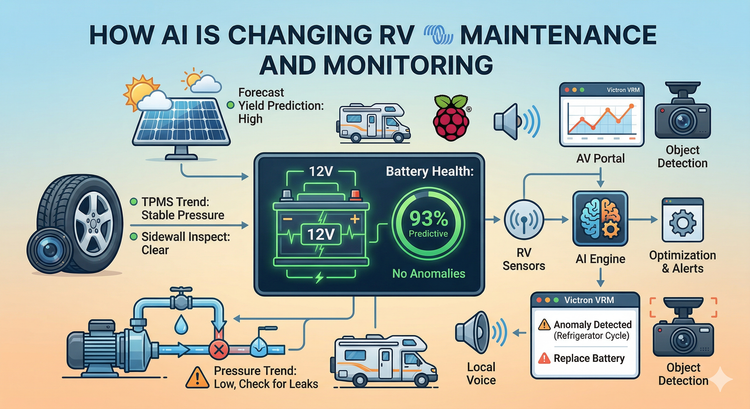
RV monitoring is a mess. Your propane sensor has one app. Your battery monitor has another. Your tire pressure sensors have a third. Your tank levels might have a fourth, or they might just be a row of LEDs on a panel that reads "1/3, 2/3, Full" and is wrong half the time.
There is no single system that does everything well. Every option involves trade-offs between cost, accuracy, integration, and complexity. Here is what actually works, based on building and running these systems in real rigs.
Option 1: Victron Ecosystem ($750-1100)
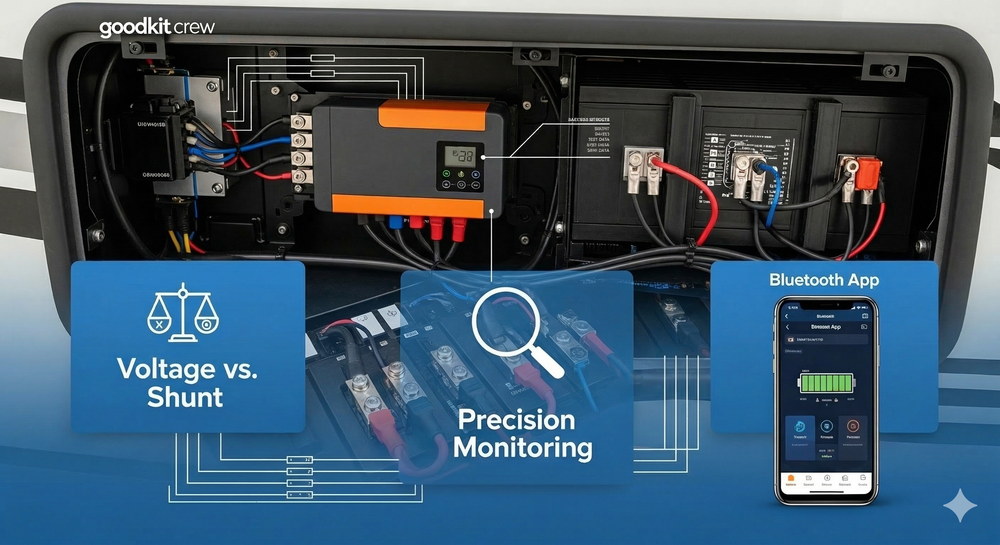
Victron makes the best battery and solar monitoring hardware available. Their SmartShunt ($120), MPPT charge controllers ($200-400), and inverters communicate over VE.Direct and VE.Can protocols. The Victron GX device ($250-350) ties it all together with a local dashboard and remote monitoring via VRM.
What Victron Does Well
- Battery state of charge: accurate, reliable, properly calibrated
- Solar production monitoring: real-time and historical
- Inverter/charger management: full control and logging
- Remote monitoring: VRM portal works globally with cell connection
What Victron Does Not Do
- Propane monitoring
- Fresh/gray/black tank levels
- Tire pressure
- Temperature monitoring (fridge, freezer, ambient)
Total cost for a basic Victron setup: $750-1100. Worth it for the battery and solar side. But you still need separate sensors for everything else.
Option 2: BLE Sensors (Mix and Match)
Bluetooth Low Energy sensors are cheap, battery-powered, and available for almost every measurement you need. The downside: each one has its own app, and nobody has built a unified dashboard that combines them all cleanly.
Recommended BLE Sensors
- Mopeka Pro Check (~$45): Ultrasonic propane tank sensor. Magnetic mount, BLE broadcast, accurate to 5%. Best propane sensor available.
- Xiaomi LYWSD03MMC (~$6): Temperature and humidity sensor. Flash with ATC firmware for open BLE broadcasts. Best value sensor in existence. Use for fridge, freezer, engine room, basement storage.
- Generic BLE TPMS (~$30/set of 4): Tire pressure monitoring. Basic but functional. Battery life varies.
Option 3: CAN Bus Direct (Pi + PICAN Duo)
If you want a single system that reads everything, you can build one. A Raspberry Pi with a PICAN Duo CAN bus hat can read RV-C protocol data directly from your coach's CAN bus network. This gives you access to tank levels, battery data, slide positions, leveling jacks, and any other system that communicates on the bus.
The catch: this requires real technical knowledge. You need to understand CAN bus wiring, RV-C DGN numbers, and be comfortable writing Python scripts or configuring open-source dashboards. It is not plug-and-play.
Practical Recommendations
- Budget build (under $100): Skip the unified dashboard. Use Mopeka for propane, Xiaomi sensors for temperature, and your existing panel for tanks.
- Mid-range ($300-400): Add a Victron SmartShunt for battery monitoring and Mopeka sensors for tanks. Run each app separately.
- Full integration ($800-1500+): Victron for power, Raspberry Pi with CAN hat for coach systems, BLE gateway for sensors, and a custom dashboard (Grafana, Home Assistant, or custom web UI). Plus your time.