How AI is Changing RV Maintenance and Monitoring
AI in Your RV: Not Science Fiction Anymore
A few years ago, "AI in your RV" meant a GPS that could reroute around traffic. Today, it means systems that predict when your water heater is about to fail, cameras that detect tire damage before you notice it, and monitoring platforms that learn your power usage patterns and optimize battery charging automatically.
Some of this is genuinely useful. Some of it is marketing fluff. Here is what is actually worth paying attention to.
Predictive Maintenance
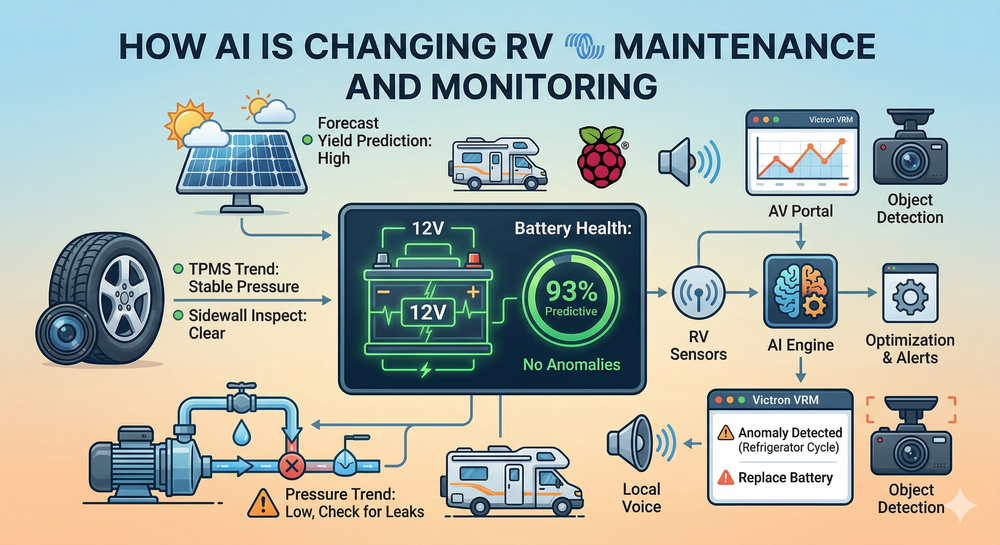
This is the biggest practical application of AI in RVs right now. Instead of replacing parts on a schedule or waiting for something to break, AI systems analyze sensor data over time and flag anomalies before they become failures.
What it looks like in practice: A monitoring system tracks your house battery voltage, charge/discharge cycles, and temperature over weeks. When the pattern shifts -- say, the battery is not holding charge as well at the same temperature -- the system alerts you that the battery is degrading. You replace it on your schedule, not on the side of the road.
The same concept applies to:
- Refrigerator compressor health -- temperature cycling patterns change before a compressor fails
- Water pump pressure -- gradual pressure drops indicate a developing leak or pump wear
- Tire condition -- TPMS data trends can predict slow leaks before they become blowouts
- Generator runtime -- fuel consumption and output patterns flag maintenance needs
This is not theoretical. Victron's VRM platform already does basic trend analysis on battery data. The open-source community has built more sophisticated anomaly detection on top of InfluxDB and Grafana.
Smart Energy Management
RV electrical systems are getting complicated. Solar panels, lithium batteries, shore power, generators, inverters -- managing all of these manually is a full-time hobby. AI can help.
Intelligent load management: An AI system that knows your power generation (solar yield, shore power availability) and consumption patterns can automatically prioritize loads. Run the air conditioning when solar production peaks. Defer the water heater to off-peak hours. Reduce inverter output when the battery drops below a threshold.
Solar yield prediction: By combining weather forecast data with your panel configuration and historical production, AI can predict tomorrow's solar yield and adjust today's power budget accordingly. Cloudy day coming? The system charges more aggressively from shore power today.
Victron's ESS (Energy Storage System) does some of this already. For DIY builders, Home Assistant with the Forecast.Solar integration can approximate it, though the setup is not trivial.
AI-Powered Cameras and Vision
This is where things get interesting -- and where a lot of the hype lives.
What is real today:
- Backup cameras with object detection that warn you about obstacles, people, or pets
- Dashcams with lane departure and collision warnings (Garmin, Viofo)
- Security cameras with person/vehicle detection for campsite monitoring
What is coming:
- Tire inspection cameras that detect sidewall damage, tread wear, and bulging
- Roof inspection drones that identify sealant failures and damage
- Automated leveling systems that use terrain analysis
The camera hardware is cheap. The AI processing is getting cheap. The main barrier is integration -- nobody has built the "one system that does everything" for RVs yet.
Voice Control and Natural Language
Alexa and Google Home work in RVs if you have internet. But the more interesting development is local voice processing -- systems that do not need cloud connectivity.
Projects like Home Assistant's local voice pipeline (using Whisper for speech-to-text and Piper for text-to-speech) run entirely on a Raspberry Pi. "Hey RV, what's my battery at?" gets answered without any data leaving your vehicle.
For boondockers with no cell signal, this is the only voice control option that actually works.
What You Can Set Up Today
You do not need to wait for manufacturers to catch up. Here is what you can do now with off-the-shelf hardware and open-source software:
- Basic monitoring with trend alerts: Raspberry Pi + sensors + InfluxDB + Grafana. Set up threshold alerts and watch for trends manually.
- Smart energy management: Victron system + VRM portal. The VRM cloud does basic AI analysis on your battery and solar data for free.
- AI dashcam: Viofo A129 or similar (~$150) with ADAS features. Not RV-specific but the collision warnings work on any vehicle.
- Local voice control: Home Assistant on a Pi with Wyoming voice satellite. Requires some setup but works without internet.
The Bottom Line
AI in RVs is real and useful -- but mostly at the "smart monitoring and prediction" level, not the "self-driving RV" level. The biggest immediate value is in predictive maintenance and energy management. The hardware is cheap, the software is increasingly accessible, and you do not need to wait for a manufacturer to build it into a $200K motorhome.
The best approach: start with sensors and monitoring (the data), then layer intelligence on top. You cannot predict failures if you are not measuring anything.