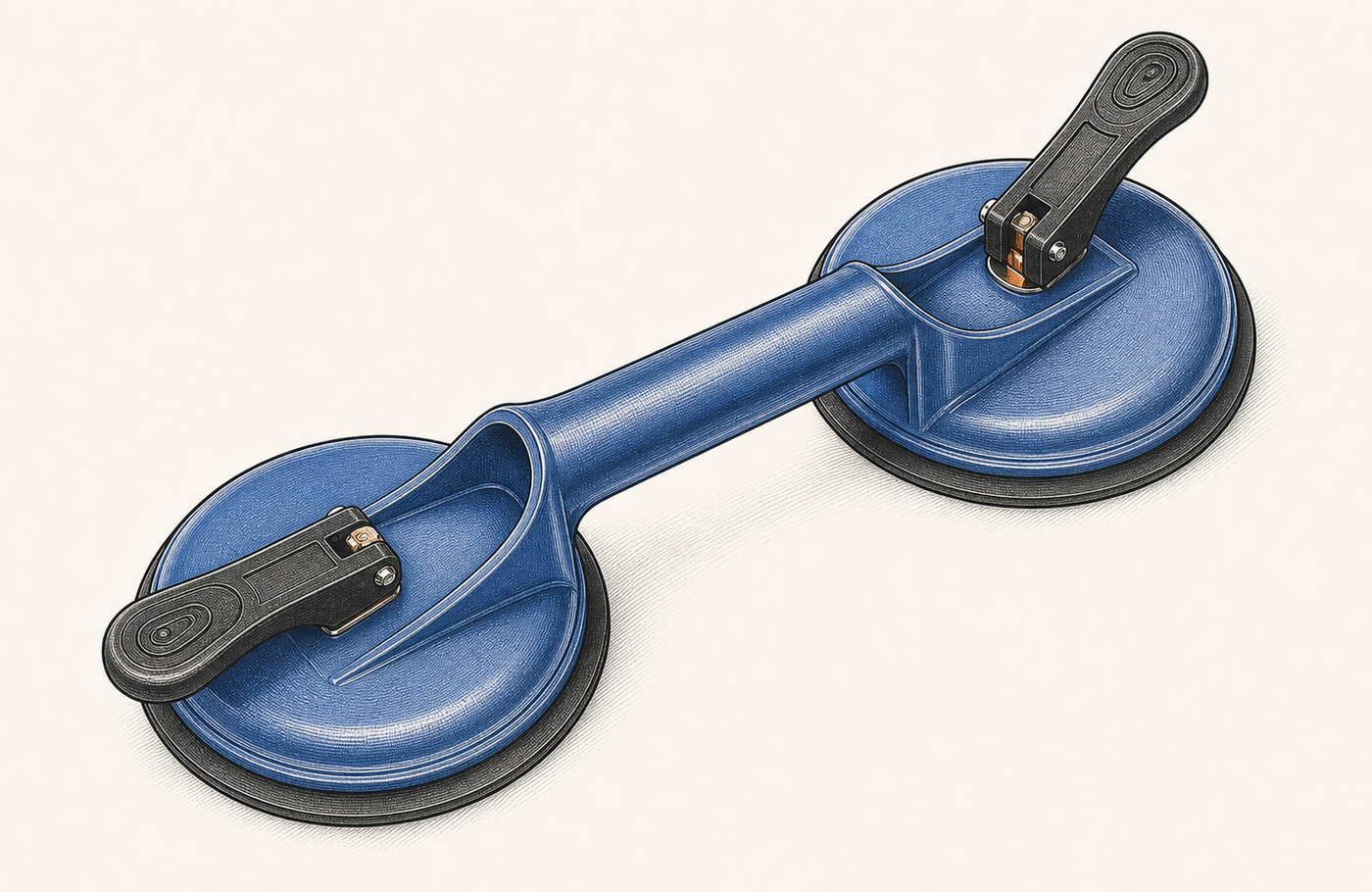
The FCHO double suction cup is sold for lifting glass and tile. We use it for something much less conventional: holding onto the bottom of our boat while cleaning the hull underwater.
That sounds like a minor convenience until there is current running through the anchorage or a light swell moving the boat above you. Without a handhold, much of your effort goes into staying beside the hull instead of actually cleaning it. The suction cup changes that completely.
It grips wet gelcoat—and Coppercoat
Our biggest question was whether a suction cup designed for dry glass would seal reliably to a boat underwater. It does.
We have attached it directly to wet, submerged gelcoat and to our Coppercoat-painted hull. It has gripped both surfaces securely. We have also not found a section of the hull where curvature prevents it from sealing. Flat areas, gently curved sections, and the different locations we have tried have all worked.
Surface condition still matters. We clear away loose growth or grit before setting the cups so the rubber can contact the hull itself.
Secure when pulled sideways
Hull cleaning rarely loads the handle in the neat, straight lifting direction shown in product photos. We pull against it from the side as the current moves us, change our body position, and use it as a working handhold while scrubbing.
Ours has remained very secure and has not released unexpectedly under that sideways loading. That confidence is what makes it useful: once attached, we can stop fighting to stay in place and put our effort into the scraper or brush.
A game changer in current and light swell
In calm water, you can clean a hull without one. In moving water, the difference is dramatic. The suction cup gives you a temporary handhold wherever you are working, making it much easier to remain close to the hull without using a heavy weight belt simply to counter the current.
It also helps in anchorages with enough swell to keep nudging you away from the boat. Instead of swimming back into position after every movement, you stay connected to the section you are cleaning.
This is the reason the product earns a recommendation. It does not merely make the job slightly nicer; under the conditions where hull cleaning becomes frustrating, it changes the job.
Easy to move as you work
Strong suction would be annoying if releasing it required a struggle. Each cup has a hinged lever. Flip the levers up and the vacuum releases easily, allowing us to move the handle to the next section of hull while still in the water.
The cycle is simple: clear the surface, press the two pads against the hull, flip both levers down, clean that section, then raise the levers and reposition. It is quick enough that moving the handhold does not interrupt the work.
Saltwater has not caused problems
The model we bought uses aluminum handles and natural-rubber suction pads. Despite repeated saltwater use, we have not noticed corrosion, rubber degradation, loss of flexibility, or weaker suction.
We rinse marine gear when practical and store the cups clean and dry. We cannot promise how the rubber will look after many years, but there is no visible deterioration in our use so far.
The exact model
Our set is the blue FCHO heavy-duty double suction-cup two-pack sold under Amazon ASIN B0CYPYHG69. Each tool has two 4⅔-inch rubber pads joined by an aluminum bridge handle.
The listing advertises a 200-pound maximum lifting capacity. We have not tested that rating, and it should not be treated as a rating for underwater, sideways, or human-support use.
Not life-safety equipment
FCHO markets these for moving glass, tile, and other smooth materials—not for diving or personal safety. We use ours as a temporary positioning aid while cleaning in conditions where we could safely let go and swim away.
Do not use one as a substitute for appropriate swimming or diving equipment, a tether, flotation, or a safe way out of the water. Never rely on suction to keep a person from being swept away, trapped, submerged, or separated from the boat.
The bottom line
The FCHO double suction cup has become one of those odd tools that solves a boat problem far better than its intended purpose suggests. It seals securely to both submerged gelcoat and Coppercoat, tolerates sideways pull without unexpected releases, moves easily when we flip the levers, and has shown no noticeable saltwater deterioration.
For cleaning a hull in current or a light swell, it is genuinely a game changer. Recommended.
- Grips submerged gelcoat and Coppercoat securely
- Has not released unexpectedly under sideways loading
- Makes hull cleaning dramatically easier in current or light swell
- Flip levers release easily for quick repositioning
- No corrosion or rubber degradation noticed so far
- Works across the flat and curved hull areas we have tried
- Not designed or rated as life-safety or diving equipment
- The advertised lifting capacity does not describe underwater human-support use
- Loose growth or grit should be cleared before attaching the pads
Where to buy
Affiliate disclosure: As an Amazon Associate I earn from qualifying purchases.