It failed both jobs a motor lock has
We bought the Draw-Tite OML 0127 outboard motor lock on December 11, 2025 for a new outboard. The boat then spent the next six months cruising the Caribbean, with the lock exposed to the salt air and spray that any piece of marine security hardware should be designed to handle.
In June 2026, roughly six months later, we tried to remove it. By then, it had failed as marine hardware and as security hardware.
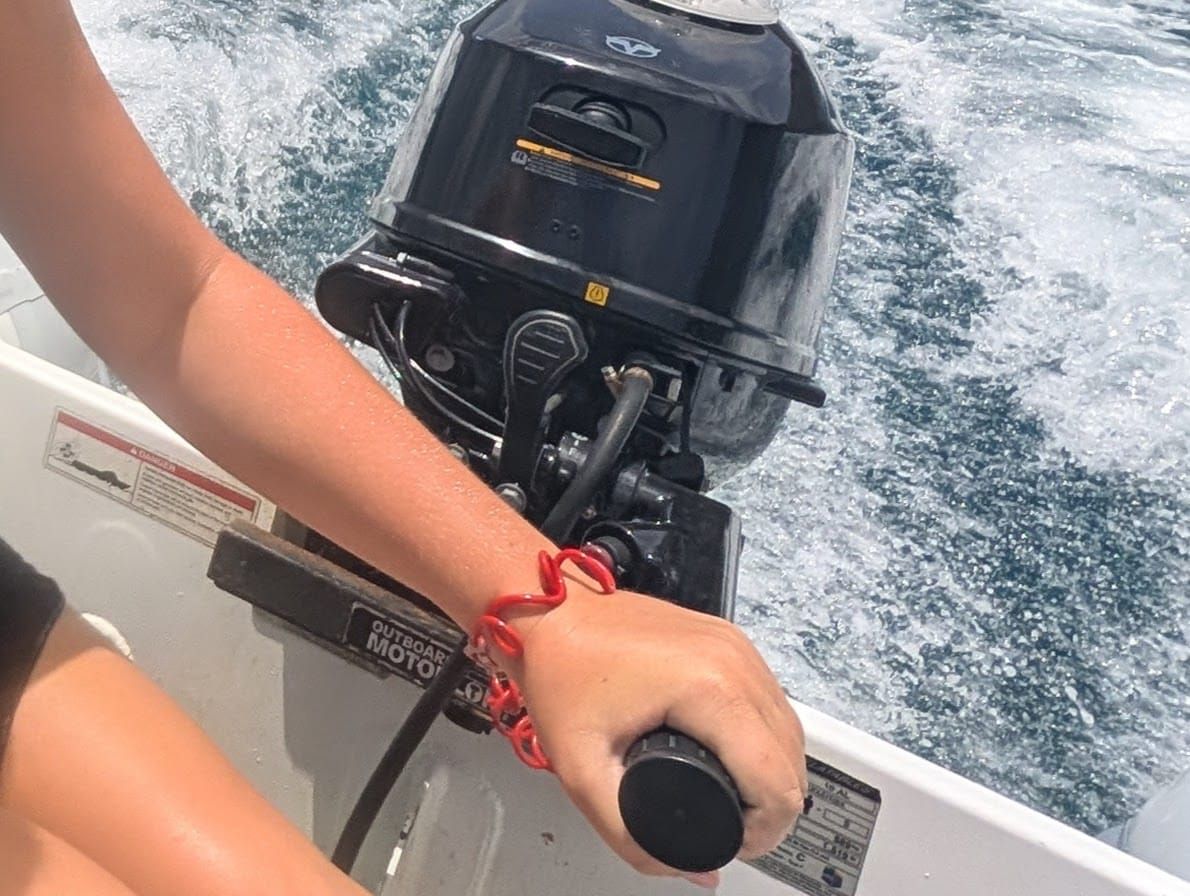
The feature photo shows the reviewed lock still installed on May 31, 2026. Rust was already forming along its top edge before we attempted to remove it in June.
Six months to a seized, rusted lock
The lock was completely rusted internally. The key would not operate it normally, and the key itself was made from metal thin and soft enough that it broke off in the cylinder while we tried to unlock it.
This was not an old lock on a neglected motor. It had been installed new, on a new outboard, only about six months earlier. A lock sold for an outboard does not get to treat saltwater exposure as an edge case. That is the environment.
The security test we did not plan
With the key broken in the seized cylinder, we had to remove the lock another way. We expected that to mean drilling, cutting, or making a noisy mess with power tools.
Instead, we used a screwdriver.
The retaining tabs at the openings were easy to bend out of the way. Working from one end to the other, the entire lock came off in roughly three minutes.
That matters more than the rust. Corrosion can disable plenty of locks, but a security product should still require meaningful tools, time, and noise to defeat. This one required a common screwdriver and a few minutes. A thief would not need the key, and would not need to attack the lock cylinder at all.
Why the design does not earn our trust
The OML 0127 slides over the outboard's clamp handles so they cannot be turned. The basic idea is sound: cover the fasteners, lock the cover in place, and make removal difficult.
But the security of the whole system depends on the ends resisting deformation. In our real removal, they did not. Once the tabs were bent, the lock's cylinder and heavy-looking outer body were irrelevant.
The product listing describes a heavy-duty lock intended to provide maximum security. Our example delivered neither durable saltwater operation nor meaningful resistance to a basic hand tool.
What we would look for instead
We have not completed a long-term test of a replacement yet, so we are not naming a new GoodKit-approved lock. The next one should have:
- A lock body and critical hardware made from 316 stainless steel
- A protected cylinder designed for saltwater exposure
- Ends or retainers that cannot simply be bent open with a screwdriver
- Anti-drill protection and a more substantial security key
- A design that secures the mounting bolts directly, when the outboard installation allows it
What we are testing next
Our next lock will be the STAZO SmartLock. It takes a different approach: a compact, thick-walled stainless-steel body encloses one of the outboard's clamp screws, with a marine cylinder and key-code card. STAZO says it fits clamp-on outboards up to roughly 35–40 horsepower.
It is harder to find in the United States than the OML 0127, although RowKraft currently lists the SmartLock. We have not tested it yet, so this is not a recommendation. We will review it after it has spent meaningful time on the boat.
The bottom line
- Simple concept
- Fits over common outboard clamp handles
- No separate padlock to manage
- Severe internal corrosion after about six months in the Caribbean
- Flimsy key broke off in the seized cylinder
- Retaining tabs bent open with a screwdriver
- Removed in roughly three minutes without cutting or drilling
The Draw-Tite OML 0127 failed because it could not survive the environment it was sold for. It failed more seriously because, once the key broke, we learned how little security the outer shell actually provided. A motor lock has one purpose: make the outboard meaningfully harder to steal. We would not trust this one to do that.
Identify the product
Amazon identifies the lock we purchased as the Draw-Tite OML 0127. Fulton also lists the same OML 0127 part number and matching design. We do not recommend it; these links are provided so readers can confirm the product.
Affiliate disclosure: As an Amazon Associate I earn from qualifying purchases.