AI Tools for Marine Navigation and Boat Monitoring
AI on the Water: What's Real
The marine world has been slower to adopt AI than automotive or aviation, but that is changing. For cruisers and liveaboards, the most useful AI applications are not the flashy autonomous navigation demos -- they are the quiet systems that help you make better decisions about weather, maintenance, and energy management.
Weather Routing and Passage Planning
This is where AI has the most mature and immediately useful marine applications.
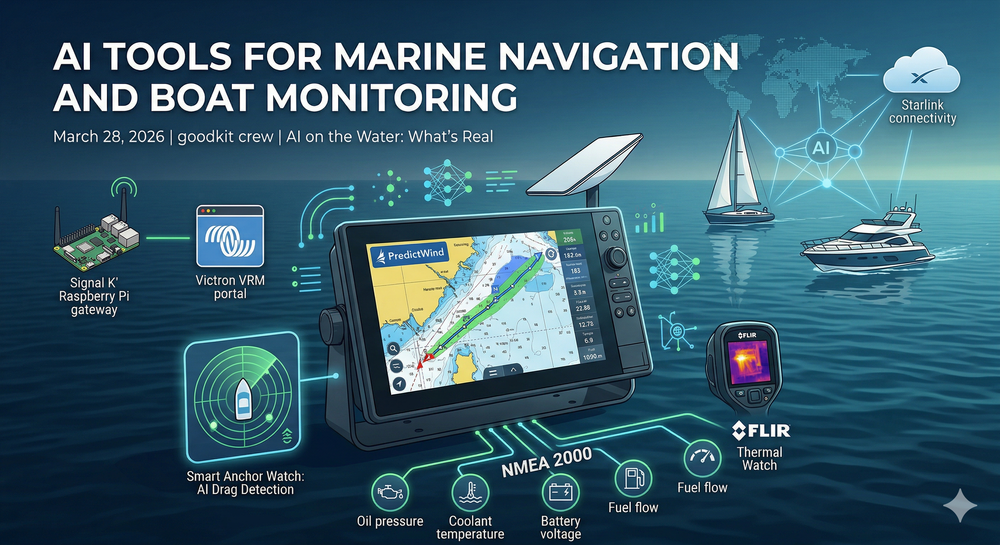
PredictWind: Uses machine learning on multiple weather models (GFS, ECMWF, SPIRE, etc.) to generate optimized passage routes. It does not just show you the weather -- it calculates the fastest or most comfortable route based on your boat's polar diagram, sea state, and current forecasts. Subscription-based ($25-50/month for offshore).
Savvy Navvy: Think Google Maps for boats. AI-powered route planning that accounts for tides, currents, depth, and weather. The free tier is useful for coastal cruising; the premium tier adds offshore routing.
What is actually valuable: These tools do not replace seamanship, but they process more data than any human can. When you are planning a 3-day passage and need to choose between leaving Tuesday or Wednesday, AI routing can show you the difference in comfort, fuel consumption, and arrival time with surprising accuracy.
Engine and Systems Monitoring
Marine diesel engines are expensive to repair and give subtle warnings before they fail. AI-powered monitoring catches those warnings.
What to monitor:
- Oil pressure trends -- gradual drops indicate bearing wear or oil degradation
- Coolant temperature patterns -- rising baseline temps flag heat exchanger fouling or impeller wear
- Exhaust gas temperature (EGT) -- changes in EGT indicate injector problems or turbo issues
- RPM vs speed -- a degrading ratio flags prop fouling or shaft issues
- Fuel consumption rate -- trending upward? Injectors need servicing
NMEA 2000 networks already carry most of this data. The missing piece is software that analyzes trends over time. Victron's VRM does this for electrical systems. For engine data, Maretron's N2KView has some trending capability, but true AI-powered predictive maintenance for marine diesels is still emerging.
The DIY approach: log NMEA 2000 data to InfluxDB via Signal K on a Raspberry Pi, then set up Grafana alerts on trend deviations. It is not fancy AI, but it catches the same problems.
Battery and Energy Management
Boats with solar, wind, and lithium battery banks face the same energy management challenges as RVs -- but with more variables (wind generation, engine alternator, hydro generator while sailing).
Smart charging: Victron's adaptive charging algorithms already adjust charge profiles based on battery condition and temperature. The next step is AI that optimizes across all energy sources -- prioritizing solar during the day, scheduling engine charging for optimal fuel efficiency, and predicting energy needs based on your planned route.
Anchor watch: Several apps now use ML to learn your anchor's holding pattern and alert you to dragging more accurately than simple GPS radius alarms. Anchor alarm apps on iOS and Android have gotten significantly smarter.
Computer Vision at Sea
AIS + camera fusion: Systems like Orca AI (commercial) combine AIS data with camera feeds and radar to create a comprehensive traffic picture. For recreational boats, this is overkill today, but the tech is filtering down.
What is practical now:
- Thermal cameras (FLIR) for night watch that can detect objects not on radar
- Underwater cameras with fish/bottom detection for anchoring
- Dinghy and deck cameras with motion detection for security at anchor
What is coming: Affordable collision avoidance systems that combine camera, radar, and AIS into a single intelligent alert. Sea Machines and Orca AI are building this for commercial vessels; recreational versions are probably 3-5 years out.
Communication and Connectivity
Starlink changed everything for offshore connectivity, and AI applications need connectivity to be most useful. With Starlink Maritime (or the cheaper residential hardware that many cruisers use), AI-powered weather routing and remote monitoring become viable even mid-ocean.
AI-assisted radio: Software-defined radio (SDR) with AI decoding can pull more information out of HF radio signals -- better weatherfax reception, automated NAVTEX processing, and AIS reception at extended ranges.
What You Can Set Up on Your Boat Today
- Weather routing: PredictWind or Savvy Navvy subscription. Immediate value for passage planning.
- Systems monitoring: Raspberry Pi + Signal K + NMEA 2000 gateway. Log engine and electrical data, set up trend alerts.
- Smart energy management: Victron system with VRM. Free cloud portal with basic analytics.
- Enhanced anchor watch: Anchor alarm app with ML-based drag detection.
- Thermal night watch: FLIR Scout or similar handheld thermal camera (~$300-500 for entry level).
The Bottom Line
AI on boats is most useful today for two things: making better weather and routing decisions, and catching maintenance problems before they strand you. Both of these have immediate, practical applications with existing hardware.
The autonomous navigation stuff is exciting but not relevant for most cruisers yet. Focus on monitoring and decision support -- that is where AI saves you money and keeps you safe today.
Start with data collection (sensors + logging), add intelligence later. You cannot predict what you are not measuring.